
Conceived for the unique acoustic of San Francisco's Davies Symphony Hall, Brant's virtually unclassifiable work places two conductors and countless musicians in multiple locations within the hall. SFS Media's binaural issue is the first time I've been able to close my eyes, focus on the music, and begin to make sense of Ice Field's divine chaos.
— Stereophile

Mixing: The Vivid Orchestra, the Disappearing Recording
A mix that works disappears, leaving only the music. On orchestral and film score recording as construction in service of the performance, not a document of the room.
Microphones in an orchestral session are there for a variety of reasons beyond balance and spatial imaging: for texture, colour, presence, dimension, flexibility. The primary work of balancing sits with the players and the conductor, not the microphones. The microphones capture different qualities of sound: the air around a string section, the physical sound of a bow scraping across the strings, the bloom of a brass chord in a large room. If the balance of the orchestra isn't working acoustically in the room, no amount of mixing will save it. The performance has to be right first. What comes after is something else.
Balance and level matter in any mix; they're the foundation. But in large-scale orchestral work, if the session has been well produced and performed, they're largely given. The interesting questions are different ones. Where is the listener placed in relation to the music? How close do the strings feel? Does the ensemble have depth and dimension, or does it feel flat? And perhaps most importantly, what does the listener need to focus on at any point in time?
Capturing the Intent, Not the Event
A recording and a performance are two fundamentally different things. A performance exists in a specific room, at a specific moment, with a specific acoustic. The listener is physically present: they see the conductor, they watch the soloist, they are surrounded by other people enjoying the same performance. That experience is irreplaceable, and it cannot be fully recreated through speakers or headphones, however good they are.
A recording is a different proposition. What I aim for is a listener who is fully immersed in the music and not conscious of the mechanics of the recording. I want it to feel real, hyper-real even, which is not the same as documenting reality. It's the suspension of disbelief you feel watching a great film, wrapped up in the story rather than the production behind it.
To get there I use whatever the music needs, a single array or a great many microphones, shaping and processing wherever it helps. No tool is off the table and no convention is sacred. But the work can only reveal and support what the players and the artist already brought to the room; it cannot manufacture what was not there. That is why the performance has to be right first.
I remember a mix that was mostly complete, though there were still several technical things I wanted to address. The director came in with the composer to listen. At the end of the playback the director was in tears, genuinely moved by what he was hearing; the composer was visibly happy. I printed that version and left it there.
The things I still wanted to fix were mine, not the music's. A reaction that immediate from the client is the surest sign a mix is done: not because the technical questions have been answered, but because they have stopped mattering. There is no mix left to hear, only the music. That is the only definition of finished I trust, and it does not always arrive when I expect. Sometimes it takes far longer, and the whole job is getting there. But once it has, chasing the last few things I might have changed would only risk breaking the very thing that told me it was done.
Perspective
Where is the listener located relative to the ensemble, and how is the ensemble laid out within the available sound field? This might sound abstract, but it has very concrete consequences. A recording where nothing sits in its own place, where the strings and the brass and the percussion all seem to occupy the same plane, quickly starts to feel unnatural, even if the listener can't articulate why. Without a coherent perspective, the ensemble loses dimension. It becomes a wall of sound rather than a world of sound.
In a concert hall, perspective is partly determined by where you're sitting. Front stalls, back of the circle, off to the side: each position gives you a different relationship to the orchestra. On a recording, that relationship has to be constructed. And in film scoring, where the orchestra is often recorded in sections across multiple sessions, sometimes in different rooms in different countries, there is no single acoustic reality to refer back to. Captured faithfully, fragments recorded in different spaces tend to sound unmatched and detached rather than like a single ensemble. The perspective the listener experiences has to be constructed, shaped by the artist's creative intent. But it still has to feel believable, so that nothing pulls the listener out of the music.
What feels believable also depends on what the listener already knows. With repertoire they hold closely, a Beethoven symphony, say, many listeners prefer the ensemble in front of them, as it has always been; spreading it around the room distracts from music they know intimately. With contemporary works, where there is no inherited expectation, the same listeners are far more open to being surrounded.
Presence
Closely related to perspective is presence, and it's what often distracts me when listening to orchestra recordings. Presence here means how close or far an instrument or section feels to the listener, its perceived proximity. And while it might seem like a subtle thing, it has an enormous impact on how natural and coherent an ensemble sounds.
A common issue is uniformity: everything feeling roughly the same distance from the listener, which produces a kind of flatness. The ensemble is balanced, the levels are fine, but there's no depth. No sense of dimension. It sounds less like an orchestra and more like a very detailed drawing of one.
Presence can fail the other way too, the brass and percussion sitting closer than the strings. Anyone who has spent time in a concert hall senses that something is off, even a listener who can't explain why. Their body knows before their brain does.
Getting presence right isn't about recreating a specific hall or ensemble layout. It's about creating a sense of physical coherence: an ensemble that feels like it exists in a believable space, with depth and dimension and a connected relationship between its parts.
Clarity as Directed Attention
The third element I'm thinking about is clarity.
The instinctive definition of clarity in a mix is separation: making sure every instrument or section can be heard distinctly. And there's a version of that which is true. But taken too far, total clarity becomes its own problem. In a dense orchestral passage with multiple competing lines, making everything audible simultaneously can actually be more confusing than allowing some elements to recede.
For me, clarity is a creative and musical choice rather than a technical one. It's about telling the music's story: keeping the key moments in focus, giving it characters and an environment.
This is something a live performance partly solves through vision. If there's a solo, you see the player. Your eyes move toward them before you've consciously decided to listen more carefully. The visual experience shapes the sonic one. A recording doesn't have that. So in those moments, a solo English horn emerging from a dense string texture, a single trumpet line cutting through a large tutti, I'm making production choices that try to do what the eye would have done in the room. Not obviously. Not in a way the listener should notice. Just quietly directing attention toward what the music is asking them to hear.
What Success Actually Sounds Like
I want to end with something a conductor said to me after listening back to a completed score mix. I won't name the project, but it was a large orchestral work recorded in sections: sessions spread across multiple facilities, different rooms with different acoustics. Nothing about how it was made resembled a single ensemble playing together in a single space.
When he listened back, he said, with some surprise, that it sounded like a really cohesive ensemble.
It's probably the nicest thing anyone has ever said to me about my work. Not because it sounded like a specific hall, or because it accurately documented a performance that never actually happened in that form. But because it sounded natural. Believable. Like something that could exist.
That's what I'm working toward on every project. Not a photograph of a moment. Not a simulation of a seat in a concert hall. Something that sounds like a world, with depth, dimension, directed focus, and a perspective that draws the listener in and keeps them there.
Because ultimately that's what the music is asking for. And serving that is the only brief that really matters.
For a detailed, technical account of these ideas in practice, including the full signal path and a mix you can listen to, see my creative mix notes for my ECHO Project contribution: https://apl-hud.com/echo-database/

When a Mix “Doesn’t Feel Right”: Listening to the Intention Behind Notes
A mix isn’t finished just because I’m satisfied with it. If the client isn’t feeling what they hoped to feel, then it isn’t finished.
Generally speaking, when I am mixing, the point at which I feel I can stop is when there is no longer anything that bothers me. By that I mean I can listen through feeling emotionally connected to and fully engaged with the music, without anything pulling me out of that experience. I want to forget about the mix and simply enjoy the music.
But this isn’t the final measure.
A mix isn’t finished just because I’m satisfied with it. If the client isn’t feeling what they hoped to feel, then it isn’t finished.
When a client reviews a mix, requests such as “can the violins have more presence?”, “can you bring the trumpets down a touch?”, or “can the overall mix have a little less reverb?” are straightforward. These are tangible, practical adjustments.
But occasionally the feedback is different:
“I’m not sure… it’s just not how I imagined it would be. It’s all there, but it doesn’t feel right.”
There’s no obvious fader to move or parameter to change in response to that.
Ideally, through discussion, you might arrive at a reference or some shared language that hints at a new direction. But sometimes there just isn’t clarity, only the sense that something isn’t landing emotionally.
In those moments I try to step back completely from the minutiae. Instead of asking what needs to change, I ask what I may have misunderstood.
In the case of a film score, I’ll think about the broader world of the project. What kind of storytelling is this? How does the music sit within that world? Is the mix reinforcing the emotional character of the piece, or subtly nudging it elsewhere? Is there something about the balance, density, or space that might be misaligned with the bigger picture? Does the mix fully align with the composer’s musical voice?
Often the eventual solution appears simple: a shift in the balance between rhythmic elements, a slightly more contained dynamic range, a more coloured reverb, or a different sense of depth. But those changes are only meaningful if they bring the emotional intent into clearer focus.
Once I have an idea of what might be misaligned, the practical work begins.
Whether in person or remotely, I’ll often present two distinct options fairly quickly. Different reverb approaches, a different dynamic approach, a different spectral balance, more or less compression. I don’t fuss over these being perfect. The goal isn’t to guess correctly. It’s to narrow the field, then repeat the process, moving closer to what feels right.
It’s a bit like an eye exam. The ophthalmologist swaps lenses and asks, “Do you prefer this… or this?” Comparing two things is straightforward. Trying to evaluate a dozen abstract possibilities is not. This approach helps us hone in quickly on what feels right. Once the client responds strongly (whether positive or negative), we’re no longer in the dark but moving with intention.
Ultimately, I’m not aiming for approval. I’m not looking for “that’ll do.”
I want the client to hear the mix and feel a sense of recognition. As though the version they imagined has finally become audible. When that happens, the notes disappear. Not because they’ve been addressed mechanically, but because the intention behind them has been heard.
That’s when I know the mix is complete.
Authorship in Immersive Music
A reflection on authorship in immersive music, exploring the differences between authored and exploratory approaches, and why informed choice matters.
When it comes to immersive music production, much of the current discussion centres on whether object-based or channel-based approaches should form the basis of master deliverables. Proponents exist for each, but in practice there is rarely a single “best” option. The appropriate approach depends on the project at hand, both technically and artistically, but also on something less frequently discussed: authorship. In many cases, the most effective solution is a considered combination of the two approaches.
For clarity, I’m drawing a distinction between mixes where the experience is intentionally authored; with instruments and vocals combined with their effects, balanced against other elements, and presented within a deliberate spatial framework — and approaches where instruments and effects are delivered separately; allowing space, balance, and perspective to shift dynamically based on listener position. In the latter case, moving closer to a source may change early reflections, alter the direct-to-reverberant ratio, and rebalance elements relative to one another.
As immersive delivery expands across platforms, particularly in virtual and augmented reality, there has been increasing advocacy for fully object-based production and delivery. Much of this enthusiasm reflects very real platform and technology needs, especially in contexts where the listener is expected to move freely through a virtual space. Those priorities are valid. They do not, however, always align perfectly with the priorities of artists creating authored musical works, and it’s important that artists understand the implications of choices made during production.
Dolby Atmos, while adaptable to many uses, was originally developed for cinema, for narrative storytelling, with a key goal of maintaining the creator’s intent across a wide range of playback environments. By contrast, many newer immersive technologies are conceived from the outset for virtual or interactive experiences. A loose comparison might be this: traditionally, music is presented much as one might hear an ensemble perform. The listener sits back, and placement, balance, and timbre are shaped by the performers and the space. In virtual environments, the goal is often the opposite. The listener may walk into the ensemble, move between sections, or place their ear next to a single instrument. Achieving this convincingly requires not only significant processing, but also a high degree of control. There is nothing inherently wrong with this, provided it aligns with the intent of the work and is understood by everyone involved.
Object-based masters are essential for exploratory experiences: environments that allow audiences to navigate freely and encounter a work from multiple perspectives. That does not mean they should be the default choice for all projects.
When an artist delivers a true object-based master as the primary representation of a work, they are implicitly granting permission for that work to be reassembled, rebalanced, and re-presented in contexts far removed from the original intention.
That may be desirable, but it should be a conscious choice.
Choosing an exploratory format as the primary master isn’t just a technical decision; it’s a decision about authorship. It affects how much control an artist retains over how their work is experienced, both now and in the future.
It’s understandable that different practitioners emphasise the approaches they specialise in. What matters is that artists are given a clear picture of the implications of those approaches, rather than being led to believe that one method is universally “best” or inherently future-proof.
There is room for both authored and exploratory experiences. Production methods and deliverables can, and should, adapt to the type of experience being created, with the creator fully aware of what those choices entail. And while advances in stem-splitting and re-rendering technologies may eventually blur some of these boundaries, that doesn’t mean we should unknowingly deliver a de facto multitrack master by default.
“PLATES” — My Approach to Immersive Music Recording & Mixing for Cinema & Home Entertainment
An outline of my approach to immersive music recording and mixing for film, using a “plates” framework to think about spatial intent, translation, and collaboration with composers across cinema, home, and stereo playback.
When looking at a single shot in a film, what appears to be a single, striking image is often constructed from multiple plates (e.g. background, midground, foreground). It’s a loose analogy, but it reflects how I approach mixing for immersive formats.
I keep all sources and microphones organised into a small number of distinct “plates,” and I generally avoid placing elements between plates unless there is a very specific musical or narrative reason to do so.
As humans, we have remarkable stereophonic acuity, especially in the frontal plane. Outside of that plane, however, our ability to localise sound becomes significantly less precise. Phantom imaging relies on having a source on either side of the head; attempting to position a sound between, for example, the left channel and left side channel often produces a vague or unstable result unless there is a speaker exactly at that position.
Even then, localisation away from the frontal plane is imprecise without turning to face the source - which is obviously not something we want audiences doing while watching a film. Add to this the enormous variability between cinema layouts and home playback systems, and the potential for unintended surprises increases rapidly.
My approach, derived from three decades of working in multichannel formats, is designed to minimise those surprises while still delivering a large, impactful soundstage. This applies across cinema, home entertainment, and also stereo playback. While I’m an advocate for immersive formats, stereo remains the dominant listening format for most end users outside of theatrical presentation.
For film soundtracks (excluding objects for the moment - I’ll return to those in a future post), I work primarily in 7.1.2, which I treat as three distinct stereo fields, or plates:
Front (LCR)
Side / Top (Lss Rss Ltc/Rtc) - another LCR
Rear (Lsr Rsr)
Within this framework, I avoid panning material to intermediate positions between plates. I also tend to avoid the “wides”. If, for example, the screen width is only half the room width and the proscenium speakers / wides are a significant distance from the screen edge, image focus can easily be destabilised in ways that are highly room-dependent.
My primary concern is that each plate functions as its own cohesive stereo image, while correlation between plates is kept to a minimum (correlation here being meant in a broad musical and perceptual sense, encompassing phase relationships, timbre, tonal balance, colour, and content). This is for two reasons.
First, when the three plates are collapsed into a single stereo image, width and a strong sense of depth are retained with minimal colouration. Second, this approach produces an expansive soundfield while avoiding the sensation that everything is sitting between the loudspeakers and the listener - an effect that can be powerful when used intentionally, but when unintentional can feel somewhat claustrophobic.
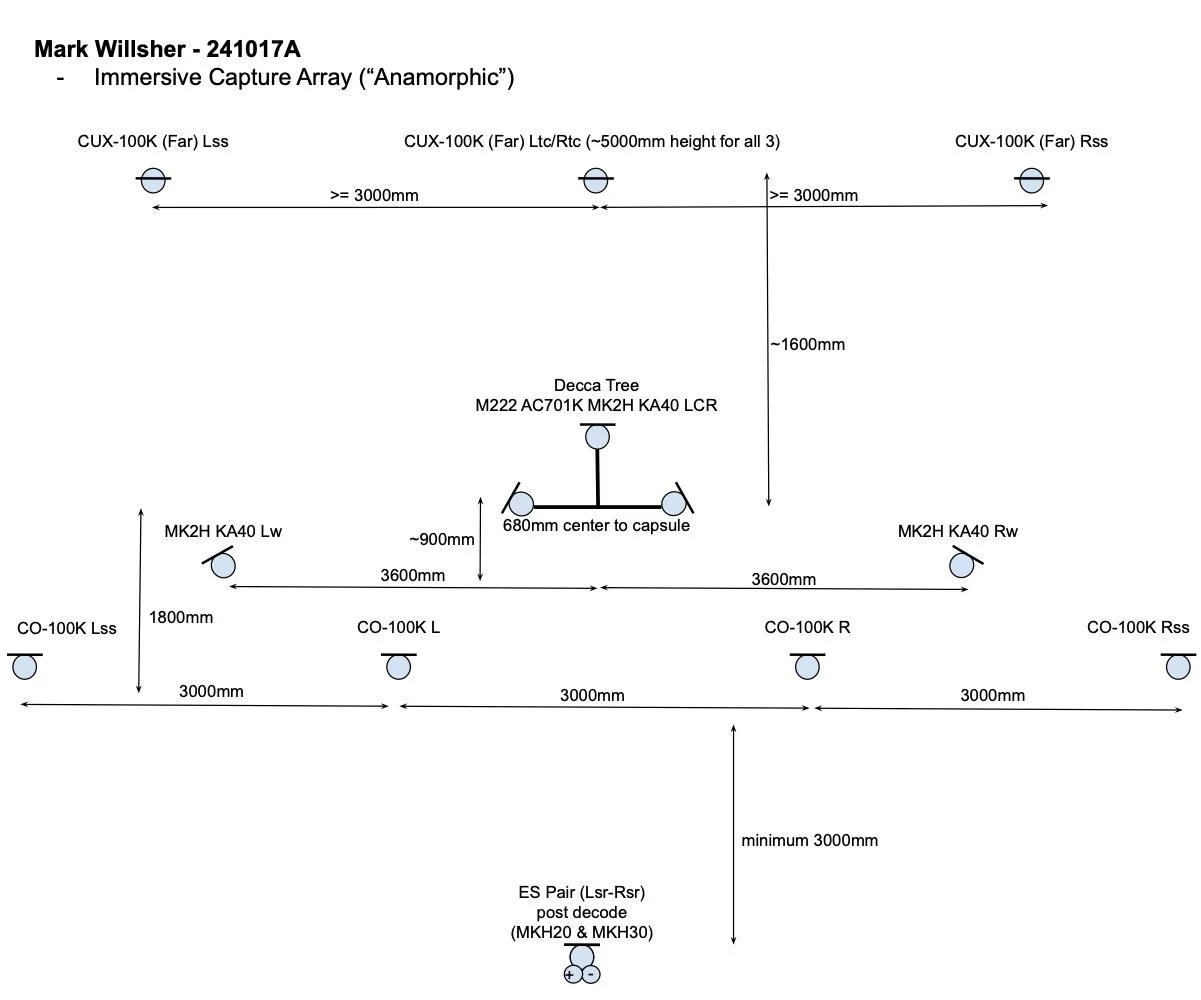
These principles are also the foundation of my anamorphic microphone array, which is listed on the Echo Project site under P3H Arrays. The array translates into three functional plates:
• A front plate, providing precision and definition, keeping focus anchored to the screen
• A mid plate, expanding width and height while maintaining a high proportion of direct sound: the goal is scale, not reverberation
• A rear plate, introducing highly diffuse energy that enlarges the soundfield without creating the impression that specific instruments or sources are located behind the audience
There are, of course, narrative moments where placing an element behind the listener is appropriate. When that’s required, I’ll typically address it using objects - which is a separate discussion.
A question that often arises is why I favour 7.1.2 rather than 7.1.4. The primary reason is theatrical translation. In cinema playback systems bed channels (arrays) and objects behave quite differently, and array delays are applied as part of the room calibration process - dependent on room size and geometry. I want the height information to remain as part of the same spatial architecture as the side and rear arrays, rather than becoming detached from them. In practice, moving height information entirely into objects can change perceived scale and width in theatres from what one might expect when working in a music mix room.
It’s also worth noting that this approach translates very well to consumer 7.1.4 environments. While the production format is 7.1.2, the spatial relationships remain coherent and scale effectively when rendered into typical home immersive layouts.
For me, the plates approach is ultimately about preserving narrative focus, musical intent, and spatial scale - not just in one type of playback environment, but across the full range of ways audiences experience film music.
Immersive Audio for Film Scores: What Actually Matters?
A surprising number of film scores—especially outside major studio features—are still mixed or premixed in 5.1. For composers, this is no longer ideal, and there are important reasons why: both for the film and for the soundtrack album.
There are many ways to approach this topic, but I want to focus on what actually matters for composers, since in most cases, the composer is my client.
A surprisingly large number of film scores - especially outside major studio features - are still mixed/premixed in 5.1. In my view, this is no longer ideal for composers, and there are meaningful reasons why: both for the film and for the soundtrack album.
1. Why Immersive Mixing Matters for the Film (Even If the Deliverables Say 5.1)
A question I get often is:
“Why bother mixing beyond 5.1 if the film’s delivery spec is only 5.1?”
For most projects, my preference is to deliver a set of 7.1.2 stems (more on that in a future post).
To clarify a few points that often come up in this discussion:
I always discuss formats with the re-recording mixer first.
I am not advocating for casually sending object-based mixes to a dub stage.
When 5.1 Becomes a Liability
A few years ago, on two different films mixed at two different facilities (in different countries), the deliverables were explicitly 5.1.
So I mixed the score in 5.1 and delivered 5.1 stems.
Later, when I heard the 5.1 printmasters, I noticed - in both cases - strange phasing artifacts in the music. After some investigation, I discovered:
the films had actually been mixed in Atmos,
the final 5.1 deliverables had been generated as re-renders,
and my 5.1 stems had been upmixed to 7.1.2 using an upmix plugin during the film mix.
Suddenly the phase anomalies made perfect sense.
The deeper discovery was this:
I found that quite a few post facilities now run their entire workflow through the Atmos Renderer for all projects, even if the project isn’t officially an Atmos deliverable.
*I’m not suggesting that every facility works this way, but I’ve encountered it often enough to consider it a fairly common workflow.
Why?
It simplifies multi-format deliverables via the Dolby Renderer.
It future-proofs the mix if the film later receives an Atmos release.
It allows them to “upsell” an Atmos version without redoing the entire mix.
Is this bad practice?
Not at all, but it is something composers and score mixers should be aware of as it affects how their work translates downstream.
Why 5.1 Music Is a Missed Opportunity
If the final stage is working in Atmos, strict 5.1 stems are a limitation:
reduced spatial clarity,
less stable imaging,
the score may blend less elegantly with dialogue and FX,
extra work required on the dub stage (and rarely enough time for it).
A re-recording mixer once told me this:
“If you’re not going to deliver an immersive premix, just send stereo stems - it’s easier to work with in Atmos than 5.1.”
That tells you everything. How significant this is will vary with the style of the score, but the underlying point remains.
2. Why Immersive Mixing Matters for the Soundtrack Album
Regardless of anyone’s personal feelings about Atmos for music:
Dolby Atmos matters for soundtrack albums in 2025.
Not in a hype-driven way—in a practical, business-driven way.
Here’s why:
Apple playlist placement
More likely to be added to Apple editorial playlists if a Dolby Atmos/Apple Spatial version is available.
Higher royalties for the artist/composer
Apple pays higher per-stream royalties to releases with an Atmos version
even for plays in stereo.
Labels prefer (or require) immersive
Many labels now strongly prefer Atmos deliverables, and some will only take a release if an Atmos version exists.
And if you are already mixing immersively for the film, then creating an Atmos album version is a zero-friction value add.
“But theatrical Atmos and Apple Spatial aren’t the same.”
Correct - there are significant differences.
But you’re already making small adjustments when creating the stereo master, and the incremental work for an album-ready immersive master is minimal.
3. The Practical Reality for Composers
From a time and workflow perspective:
Mixing immersively for the film and creating both stereo and immersive album masters generally takes no longer than mixing 5.1 for the film and delivering a stereo master—aside from the need to QC additional versions.
But the results are meaningfully better:
Greater clarity and impact in the cinema
A more emotionally engaging spatial mix
More attractive soundtrack deliverables for labels
Better discoverability and visibility on Apple Music
In short:
Immersive mixing future-proofs your score - creatively, technically, and commercially.